Home Blog Page 2

Join the Expansion Program

Impact Group Meeting 2 2023
Complete Capture Of Ratings 2023

To enroll, the following two requirements are mandatory:

  1. Four Years in Business
  2. Expansion Plan requiring funding within the next 12 to 18 funding.

1The registration starts with an interview to establish qualifications for the Sub-Partner Program (SPP).


Provide the information required below and anticipate receiving an invite to the conference call for an interview.


WHO WE ARE

Business Meeting In The Office 2022 02 05 03 43 46 Utc
Group of businesspeople listening their boss speech - Senior manager talking to his team
  • IJJ Corporation (IJJCorp) was acquired in 2003 as a Bulletin Board. Currently, it is an OTC public company with a history of providing federal and Department of Defense information technology (IT) and facility management services.

  • Today, diversified revenue streams are established as a FurtureTech in emerging digital assets, a forerunner in defining Fintech technologies, and new market expansions to finance Core Business Initiatives.

  • The Core Business platform will evolve into a FinTech business model utilizing internal WebApps to finance business initiatives such as Business Processing as a Service (BPaaS) within our Corporation’s Social Responsibility Commitments (SRC) to include SEC applicable exemptions for raising working capital.

  • In addition, to win IT contracts, the Company will acquire federal government GSA Schedules and develop an Essential Business Application (EBA) for enterprise operations to integrate departmentally on-demand exchange of workflow throughput, project management, and administrative processing as a full-service operation.

The Sub-Partner principal Officer join IJJ Corporate Board of Directors

Shaking Worldwide Partnership Larger 2020

The Sub-Partner’s commitment is to prepare their company for expansion and, as the principal Officer, must join the IJJ Corporate Board of Directors to operate the Profit Center, as stipulated within the Merger Agreement, in exchange for funding.


The Preferred Stock will be ready to fund the expansion plan within 8 months, and the option to spin out is now executable.


Alternative Options:


  1. Spin-out Option – Executes the terms and conditions, with an option to become an EBP subscriber with selective services.

  2. Continuation of Sub-partnership – The executive staff elects to maintain the board member position, the subsidiary maintains its Business Registration, integrates administrative and operation functions into IJJ Corporation, and the Executive staff converts their profit-sharing position to 25%.

  3. Sub-Partner Joins IJJ Corporation—The board and executive staff maintain operation positions ( term period 24 months). After the steadfast period, IJJ Corporation ownership is 51%, and the Sub-Partner Team is 49%. The Business Maintains its Registration by integrating administrative and operational functions into the IJJ Corporation.


Sub-Partner Operates a Profit Center

Sub Partners Meeting

A President heads the Subsidiary, and the company is a Profit Center within the Partnership Enterprise. Management Control is the Board of Directors, and the President of the Subsidiary is a voting board member.

The Sub-Partner is required to have an expansion plan forecasted starting date of 6 to 12 months.

The Sub-Partners Profit Center, the existing Managing Principal, continues to operate their business, has access to Business Processing as a Service (BPaas) essential business application, legal consult, and Digital Marketing Services, and maintains 75% of Netprofit.

Sub-Partner has full access to Essential Business Application (EBA), a powerful full-service business enterprise application. The EBA network supports every Business Processing as a Service (BPaaS) and integrates collaborative departmental services.

Must be willing to accept Preferred Convertible restricted shares

Willing To Accept Restricted Stock

Thank you for your interest in the program. Here are some details about the agreement. They help clarify the terms and conditions of the Sub-Partner Expansion Funding and Profit Sharing Platform.

The agreement

The Exchange value offered is up to 3 times the expansion plan funding required.  The exchange is series D common preferred convertible stock converted into trading common to fund the Expansion Plan.

 The incubation period is 12 to 18 months, and the stock has a holding period between 6 to 12 months.

Welcome to the Sub-Partner Expansion Funding and Profit Sharing Platform.

The primary conditions must be agreed upon:

Sub-Partnership must have an existing business with an expansion plan and working capital.

Here’s a summary of the key points:

  1. Exchange Value: The exchange value offered can be up to three times the funding required for the expansion plan. This means that the party investing receives stock with a value potentially three times their investment.
  2. Stock Conversion: The exchange involves Series D common preferred convertible stock, which can be converted into trading common stock to fund the expansion plan.
  3. Incubation Period: The incubation period lasts between 12 to 18 months. During this period, the partnership or subsidiary is expected to receive support and guidance for business development.
  4. Stock Holding Period: The stock acquired during this agreement has a holding period of 6 to 12 months, during which it cannot be sold or transferred.
  5. Partnership Requirements: Sub-partnerships must have an existing business with an expansion plan and a need for working capital to participate.
  6. Management Control: The merger can involve a transfer of management control, ranging from 51% to 100%, from the original owner to the partner or subsidiary.
  7. Profit Sharing: The subsidiary is expected to convert into a profit center with a split of 25% to IJJ Corporation’s profit, which should contribute positively to the overall financial performance of the business.
  8. Board of Directors: During the incubation period, the principal of the Sub-partnership is granted a seat on the Board of Directors, suggesting involvement in decision-making.
  9. Exit Strategy: As part of the exit strategy, the company will receive a block of Preferred convertible stock. This stock may be valuable when the partnership or subsidiary leaves the incubation program.
  10. Autonomy for Original Owner: As a Board of Directors member, the original owner retains a level of autonomy over the operation, implying a say in the decision-making process.

It’s important to thoroughly review and understand the terms and conditions of this agreement, possibly with the assistance of legal and financial professionals, before entering into such a partnership

More Details are provided during the initial interview.

The EU Clarifies the Anti-Money Laundering Directive

8

BlockChain is a cryptocurrency and worldwide payment system. It is the first decentralized digital currency, as the system works without a central bank or single administrator. The network is peer-to-peer and transactions take place between users directly, without an intermediary. These transactions are verified by network nodes through the use of cryptography and recorded in a public distributed ledger called a blockchain.

Bitcoins are created as a reward for a process known as mining. They can be exchanged for other currencies, products, and services. As of February 2015, over 100,000 merchants and vendors accepted bitcoin as payment.

P1Research produced by the University of Cambridge estimates that in 2017, there are 2.9 to 5.8 million unique users using a crypto currency wallet, most of them using bitcoin. The word bitcoin first occurred and was defined in the white paper that was published on 31 October 2008.

It is a compound of the words bit and coin. The white paper frequently uses the shorter coin. There is no uniform convention for bitcoin capitalization.

On 18 August 2008, the domain name “bitcoin.org” was registered. In November that year, a link to a paper authored by Satoshi Nakamoto titled Bitcoin.A Peer-to-Peer Electronic Cash System was posted.

Nakamoto implemented the bitcoin software as open source code and released it in January 2009 on SourceForge. The identity of Nakamoto remains unknown. In January 2009, the bitcoin network came into existence after Satoshi Nakamoto mined the first ever block on the chain, known as the genesis block. Embedded in the coinbase of this block was the following text:

The Times 03/Jan/2009 Chancellor on brink of second bailout for banks

This note has been interpreted as both a timestamp of the genesis date and a derisive comment on the instability caused by fractional-reserve banking.

One of the first supporters, adopters, and contributors to bitcoin was the receiver of the first bitcoin transaction, programmer Hal Finney. Finney downloaded the bitcoin software the day it was released, and received 10 bitcoins from Nakamoto in the world’s first bitcoin transaction. Other early supporters were Wei Dai, creator of bitcoin predecessor b-money, and Nick Szabo, creator of bitcoin predecessor bit gold.

P2

In the early days, Nakamoto is estimated to have mined 1 million bitcoins. In 2010, Nakamoto handed the network alert key and control of the Bitcoin Core code repository over to Gavin Andresen, who later became lead developer at the Bitcoin Foundation. Nakamoto subsequently disappeared from any involvement in bitcoin. Andresen stated he then sought to decentralize control, saying:

“So, if I get hit by a bus, it would be clear that the project would go on”

This left opportunity for controversy to develop over the future development path of bitcoin. The value of the first bitcoin transactions were negotiated by individuals on the bitcointalk forums with one notable transaction of 10,000 BTC used to indirectly purchase two pizzas delivered by Papa John’s.

Commission Depository Enterprise Platform Technology (CDEP).

Cdep Stock Tradimg Section 4 1

Clearinghouse for Crypto Coins and Tokens for trading:

CDEP is the innovative designer of a globally comprehensible certification utility for the transition of cryptocurrencies into trading securities. It stands as the primary centralized digital currency system meticulously crafted to mirror the regulatory oversight principles of the Securities and Exchange Commission (SEC), leveraging the matching capabilities akin to the Depository Trust & Clearing Corporation (DTCC) and incorporating regulatory protocols reminiscent of the Financial Industry Regulatory Authority (FINRA) to govern the trading of cryptocurrencies under the auspices of CDEP Business Processing as a Service (BPaaS).

The foundational infrastructure of CDEP facilitates the seamless execution of peer-to-peer trading transactions involving cryptocurrencies, orchestrating assignations between a CDEP-certified broker on CDEP trading platforms for sellers and buyers directly.

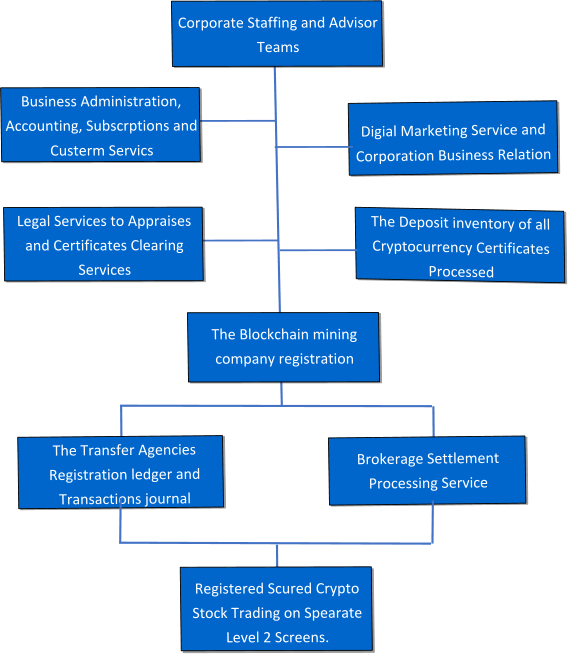
Before trading, the process entails the utilization of a Transfer Agent (TA) center to facilitate the efficient and transparent recording of crypto ownership transfer procedures to new owners. In turn, it contributes to the seamless operation of the capital markets and fosters investor confidence.

Notably, these transactions undergo meticulous scrutiny through an enterprise validation network, employing cryptographic techniques for authentication, and are meticulously recorded in a publicly accessible TA ledger known as a registered CDEP from our sub-partner customers in blockchain mining companies.

CDEP’s architectural design comprises an intricate hierarchy delineated into 36 tiers of procedural data processing distributed across six modules. Cryptographic digital assets are generated with an assignable index repository cataloged as escrow assets for subsequent allocation into buyer accounts and conversion into fiat currency. All corporate issuances are formally registered through a blockchain mining provider. These assets boast versatility, as they can be interchanged for diverse currencies, products, services, and even other stable cryptocurrencies within this CDEP IndexThis image has an empty alt attribute; its file name is Business-Structure-Chart-7-22-2023.png

A research endeavor conducted by the esteemed University of Cambridge postulates that by the year 2022, in excess of 300 million individuals will actively engage in cryptocurrency exchanges worldwide, predominantly utilizing digital crypto assets. the CDEP business model, these users are day trading, partaking in the buying and selling of deposited indexed cryptocurrencies, whereby before being authorized for trading by a broker, they undergo meticulous cross-referencing with central depository audits, thereby attaining clearance for trading operations.

The genesis of cryptocurrency as a tangible entity traces back to the seminal events of August 18, 2008, marked by the registration of the domain name “bitcoin.org.” In November of the same year, the enigmatic Satoshi Nakamoto authored a seminal paper entitled “Bitcoin: A Peer-to-Peer Electronic Cash System,” laying the conceptual foundation for the nascent digital currency paradigm. , Nakamoto unveiled the Bitcoin software as open-source code in January 2009, disseminating it via SourceForge

The identity of Nakamoto remains shrouded in mystery, notwithstanding the historicity of Nakamoto’s inaugural mining of the Genesis block, thereby heralding the inception of the Bitcoin network.

Following the advent of Bitcoin, the proliferation of open-source code facilitated the genesis of myriad coins and tokens, precipitating the emergence of the cryptocurrency industry as a burgeoning domain for commodity trading.

This codebase furnished a unique modulatory framework that seamlessly interfaces with CDEP’s transaction processing. It incorporates discernible transfer transactions augmented by tradable certifications of crypto blocks derived from the depository.

Fast-forward to the fourth quarter of 2024, CDEP is poised for imminent implementation preceding September. Our core operational ambit shall encompass the deployment and stewardship of a Centralized Depository tasked with overseeing cryptocurrency issuances on a global scale. Additionally, we envisage the integration of certificates within the comprehensive CDEP framework, serving as an impregnable ledger for cataloging cryptocurrency transactions. Concurrently, we are forging collaborative alliances with select Blockchain Mining enterprises specializing in coins and tokens.

The purported simplicity of modulation belies the multifaceted significance underpinning CDEP’s operational framework. It imbues three cardinal components:

  1. identifiable reporting,
  2. stringent registration processes, and
  3. meticulous financial disclosures encompassing corporate assets and shareholder portfolios, thereby mandating the perpetuation of qualification status.

A prerequisite for participation entails establishing a functional business model aimed at engendering market trading value through the issuance of certificates strategically underpinned by key performance indicators instrumental in delineating crypto market valuations.

Through these symbiotic partnerships, we aspire to acquaint their respective clientele with the inherent value proposition underpinning the realm of cryptocurrency trading certificates. Such collaborative endeavors are envisioned to furnish competitive equity volume trading prospects, thereby catalyzing growth and fostering innovation within the cryptocurrency market milieu.

Png;base64,iVBORw0KGgoAAAANSUhEUgAAANoAAACWAQMAAACCSQSPAAAAA1BMVEWurq51dlI4AAAAAXRSTlMmkutdmwAAABpJREFUWMPtwQENAAAAwiD7p7bHBwwAAAAg7RD+AAGXD7BoAAAAAElFTkSuQmCC

The Roadmap Updates:

0
Updates on Current and Planned Material Events Roadmap Changes: Expectations outlined in the roadmap have been updated, with the discussion of a merger removed as a...
Png;base64,iVBORw0KGgoAAAANSUhEUgAAANoAAACWAQMAAACCSQSPAAAAA1BMVEWurq51dlI4AAAAAXRSTlMmkutdmwAAABpJREFUWMPtwQENAAAAwiD7p7bHBwwAAAAg7RD+AAGXD7BoAAAAAElFTkSuQmCC

Introduction Our Core Business

0
Building Business Partnerships (BBP)Social Responsibility: We forge partnerships aligning with our Social Responsibility Commitments (SRC), integrating ethical practices to benefit communities and promote sustainability.Commission...
Png;base64,iVBORw0KGgoAAAANSUhEUgAAANoAAACWAQMAAACCSQSPAAAAA1BMVEWurq51dlI4AAAAAXRSTlMmkutdmwAAABpJREFUWMPtwQENAAAAwiD7p7bHBwwAAAAg7RD+AAGXD7BoAAAAAElFTkSuQmCC

Culture Centric Platform

0
Discover IJJ Corp’s Culture-Centric Asset Exchange Platform At IJJ Corp, our asset exchange platform is revolutionizing the cryptocurrency landscape by emphasizing shareholder values, transparency, and...
Png;base64,iVBORw0KGgoAAAANSUhEUgAAANoAAACWAQMAAACCSQSPAAAAA1BMVEWurq51dlI4AAAAAXRSTlMmkutdmwAAABpJREFUWMPtwQENAAAAwiD7p7bHBwwAAAAg7RD+AAGXD7BoAAAAAElFTkSuQmCC

Digital Marketing Services

0
The Digital Marketing Service (DMS) department's services aim to drive business traffic to our WebApps to generate sales. To succeed in the endeavor, implement...